

This year, Children’s Mental Health Week will take place from 9-15 February 2026. The theme for Children’s Mental Health Week 2026 is ‘This is My Place’ which is all about helping to ensure that people, places and services that surround children and young people can help them feel they belong.
In 2025, 6929 students from 11 Liverpool schools in years 7 to 13 took part in the Oxwell survey which is a large-scale online study conducted by the University of Oxford to measure mental health and well-being, and factors that influence them, amongst school-aged children and adolescents.
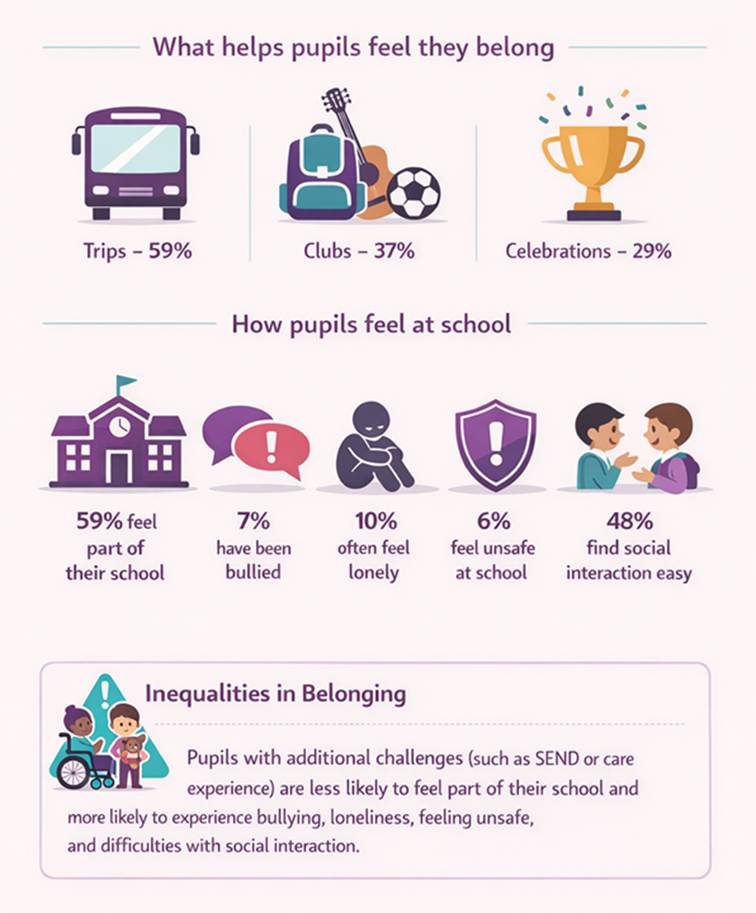
The Oxwell survey results can reveal a lot about sense of belonging amongst Children and Young People in Liverpool:
Why belonging matters
A sense of belonging is a fundamental human need. For children and young people, it is not a “nice to have” but a critical protective factor that shapes mental health, physical wellbeing, educational outcomes and life chances. From a public health perspective, belonging sits upstream of many of the outcomes we care most about – anxiety and depression, school attendance, risk-taking behaviour, and long-term health inequalities.
Yet for many children and young people today, belonging is fragile. Understanding what threatens it, and where we can most effectively strengthen it, is essential if we are serious about improving population wellbeing.
What do we mean by belonging
Belonging is the experience of feeling accepted, valued and connected to others and to places. For children and young people, this often includes:
- Feeling safe and included in school or education settings
- Having trusting relationships with peers and adults
- Seeing themselves represented and respected
- Feeling that they matter and can contribute
The Oxwell survey results suggest that when children and young people in education settings can interact freely and socially around a shared purpose like a trip, a hobby or a celebration they are more able to achieve these things that contribute to their overall sense of belonging.
Key threats to belonging
Belonging is both relational and contextual, it is shaped by families, schools, neighbourhoods, online spaces, and wider social and economic conditions. The things that disrupt sense of belonging are rarely just individual issues, they are more likely to be patterned by inequality, systems and environments.
- Poverty and social exclusion
Children growing up in poverty are more likely to experience stigma, material exclusion and reduced access to social opportunities. Not being able to afford school trips, uniforms or activities can quietly but powerfully erode a sense of belonging.
- Discrimination and marginalisation
Racism, homophobia, transphobia, ableism and other forms of discrimination directly undermine belonging. Children who experience bullying or microaggressions are more likely to disengage from school, experience poor mental health and feel unsafe in public spaces.
- Education pressures
High pressure environments, exclusionary discipline, and a narrow focus on attainment can unintentionally push some children to the margins. Children with SEND, neurodivergent children, and those with unmet emotional needs are particularly vulnerable to feeling “out of place”.
- Family stress and instability
Parental mental health difficulties, insecure housing, domestic abuse or involvement with care systems can disrupt children’s sense of stability and connection, even when relationships are loving.
- Digital and social media environments
Online spaces can foster connection, but they can also amplify exclusion, comparison and harassment. For some young people, online identity becomes a place of conditional belonging – belonging only if you look, act or perform in certain ways.
- Fragmented services
When support systems are disjointed, crisis-driven or difficult to access, children and families can feel passed around rather than held – reinforcing feelings of not being seen or understood.
Why belonging is so important
Belonging is strongly associated with:
- Lower rates of anxiety, depression and self-harm
- Better school attendance and attainment
- Reduced substance use and risk-taking
- Stronger resilience and coping skills
Importantly, belonging acts as a buffer, even in the presence of adversity, children who feel connected to others are more likely to thrive. This means that if we can make changes that help children feel they belong, it will help to protect them from some of the social and environmental factors that are more difficult to control or influence and help to prevent negative outcomes.
What works to strengthen belonging?
Evidence suggests that belonging is best strengthened not through intervention from specialist services (like mental health services) but through the environments that children and young people exist in every day, crucially how children are greeted, listened to, and supported when things go wrong.
Early years and family support
Belonging begins early – secure relationships in infancy and early childhood lay the foundations for later social connection. Supporting parents’ own sense of belonging helps avoid parental poor mental health which can indirectly but powerfully improve children’s wellbeing.
Things that make the biggest difference are:
- Relationship-based early years provision
- Peer support for parents, particularly those facing isolation
- Family hubs and community-based services that reduce stigma and increase accessibility
Education settings: The front line of belonging
Schools and colleges are uniquely placed to shape belonging because they reach nearly all children.
What works well:
- Whole-school cultures of inclusion, where diversity is visibly valued and exclusion is actively addressed
- Strong relationships with trusted adults, particularly for children who struggle academically or behaviourally
- Restorative and relational approaches to behaviour, rather than punitive systems
- Belonging-focused transitions, especially between early years, primary and secondary school
- Promoting social and emotional learning, peer connection and acting on pupil voice.
Community and youth settings: Identity, agency and connection
Community spaces often provide forms of belonging that schools cannot. Evidence highlights the value of safe, consistent spaces where young people feel ownership and choice. These settings are particularly important for adolescents, who may seek belonging outside family and school.
Youth clubs, sports teams, arts groups, faith organisations and cultural spaces can:
- Offer identity-affirming environments
- Provide informal and mentoring relationships
- Create opportunities for shared goals, teamwork and leadership
- Reduce isolation, especially for marginalised groups
Targeted support for children at higher risk
Some children need additional, tailored support to experience belonging including children who are impacted by Adverse Childhood Experiences, looked after or care experienced, neurodivergent or with SEND, refugees or from migrant families, excluded or at risk of exclusion.
Belonging is bets supported through consistent, trusting relationship, for example, mentoring, keyworker models, or psychologically and trauma informed environments and when specialised help is offered as part of inclusive universal provision.
Health and Mental Health Services: Holding belonging in mind
Children accessing health services can often feel alienated or ashamed. Embedding support in familiar and non-stigmatising setting and in a way where children aren’t made to feel different can reduce stigma and reinforce connection. Offering trauma-informed, culturally sensitive and relational approaches can help children feel understood rather than assessed.
Moving forward: Creating a belonging-informed system
If we accept that we should take belonging seriously as a public health priority, it can change how we design services and systems.
Key questions to consider in building better belonging are:
- Who feels welcome here, and who doesn’t?
- How do we hear (and act on) everyone’s voice?
- How do we provide continuity and help build trusted relationships?
Strengthening belonging does not always require new programmes. Often it means doing the same things but better, with relationships, inclusion and equity at the centre.
In a world where many children feel under pressure, unseen or excluded, creating conditions for belonging may be one of the most powerful and humane public health interventions we have.
Where to find out more and get support
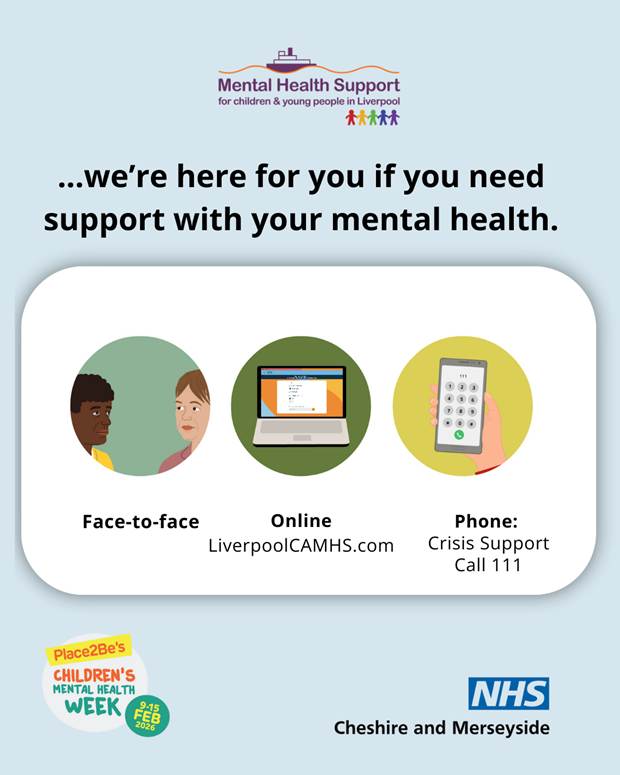
Liverpool has a partnership of organisations that work together to ensure Mental Health Support for Children and Young People. This partnership is overseeing a range of activities to acknowledge Children’s Mental Health Week which can be found on their website along with a wide range of information, guidance and access to training and support. Visit Liverpool CAMHS website.
NOW Festival
Children and young people from across Merseyside will take part in the 2026 NOW Mental Health Festival at the Epstein Theatre on 9 – 11 February during Children’s Mental Health Week.
The annual festival is organised Merseyside Youth Association’s (MYA) along with Liverpool’s Children and Young People’s Mental Health Support Partnership, NHS Cheshire and Merseyside Integrated Care Board (ICB) Liverpool Place and the Merseyside Violence Reduction Partnership.
The theme for 2026 is ‘Mental Health and the Environment’
Evidence shows that a wide range of environmental, physical and social factors in young people’s surroundings deeply affect their mental health and wellbeing and sense of belonging.
During NOW Fest 2026, we will:
- Explore what local social, economic and other factors damage or encourage good mental health and how these have changed over time.
- Highlight how these factors affect different groups of people, cause inequalities and affect the need for mental health services.
- Pinpoint what children and young people feel about their local area and what they are concerned about.
- Showcase how strong social networks and community assets are.
- Question through youth voice how these wider influences on health can be tackled by prevention initiatives
Buy tickets for the NOW Festival 2026 – Liverpool CAMHS
Place2Be
Place2Be’s official Children’s Mental Health Week 2026 resources are available for you to download! Whether you’re a primary school, secondary school, family, community group or workplace, there are activities and resources for you with ideas on how to support Children’s Mental Health Week 2026.