

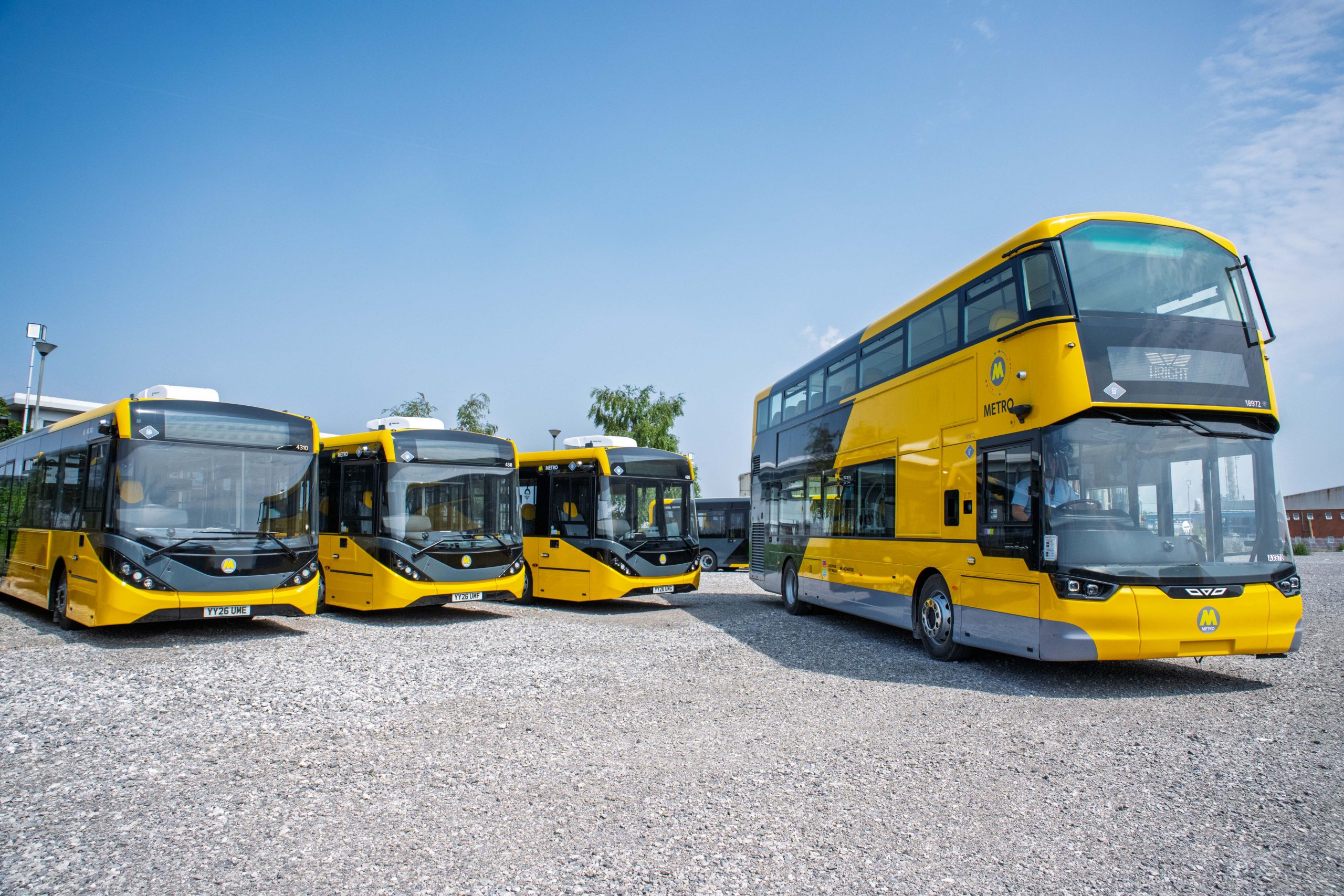
The first of more than 560 ultra-modern, low-emission buses are hitting the roads as part of the region’s bus network being brought back into public control.
Representing an investment of over £150m, the state-of-the-art vehicles are clad in the region’s distinctive yellow, black, and grey Metro livery, the buses will join 108 brand-new, publicly owned electric buses already in service.
Designed around the needs of passengers, the new vehicles will deliver cleaner, more comfortable journeys for the hundreds of thousands of people who use the bus network each day.
Manufactured entirely in the UK by Alexander Dennis Limited (ADL) in Scotland and Yorkshire and by Wrightbus in Northern Ireland, the new buses are equipped with a range of passenger-friendly features, including USB charging points and more comfortable seats.
With additional space for wheelchairs and prams as well as audio-visual announcement technology, the new fleet also represents a huge leap forward for accessibility, making bus travel easier for everyone.
The latest buses – built to the latest Euro 6 environmental standards – will also help to reduce pollution on key routes, with a 20% reduction in carbon emissions and a reduction of more than 80% in Nitrogen Oxide emissions compared to much of the current generation of buses operating in the City Region.
The vehicles are also being built to allow their conversion to battery electric once grid capacity and charging facilities are developed to support the entire enlarged fleet, supporting Mayor Rotheram’s ambition to deliver a zero-emission bus fleet across the region by 2035.
Dozens of additional single-decker electric buses are also part of this £150m investment in the new fleet, with these vehicles set to arrive in the region from 2027.
Along with the £500m investment centred on a fleet of state-of-the-art Merseyrail trains and the first new Mersey Ferry in more than 60 years, the vehicles are part of major modernisation programme which will see the City Region’s entire public transport fleet completely updated over the next few years.
The rollout of the new state-of-the-art vehicles is a key element of Mayor Steve Rotheram’s plans to revolutionise bus services in the Liverpool City Region, which include bringing the network back under local public control for the first time in more than 40 years.
Steve Rotheram, Mayor of the Liverpool City Region said: “The arrival of these state-of-the-art, low-emission vehicles marks a massive milestone on our countdown to taking back control of our bus network. We are completely renewing our fleet with ultra-modern, accessible buses that give our residents the premium, reliable experience they deserve.
“This is about building a fully integrated transport network that is fit for the future. We are creating a system that connects our communities seamlessly – making public transport the first choice for the 1.6 million people who call the Liverpool City Region home.
“From Autumn 2026, when St Helens and Wirral lead the transition into public control, we will finally have the power to design a network that puts passengers first. Combined with our new battery-powered trains, electric buses, and our brand-new Mersey Ferry, we are modernising every corner of our transport network to drive our region forward.”
Work to bring the network into public control is being delivered in phases, with services to and from St Helens leading the transition from last weekend, with Wirral to follow in October then other areas including Liverpool.