


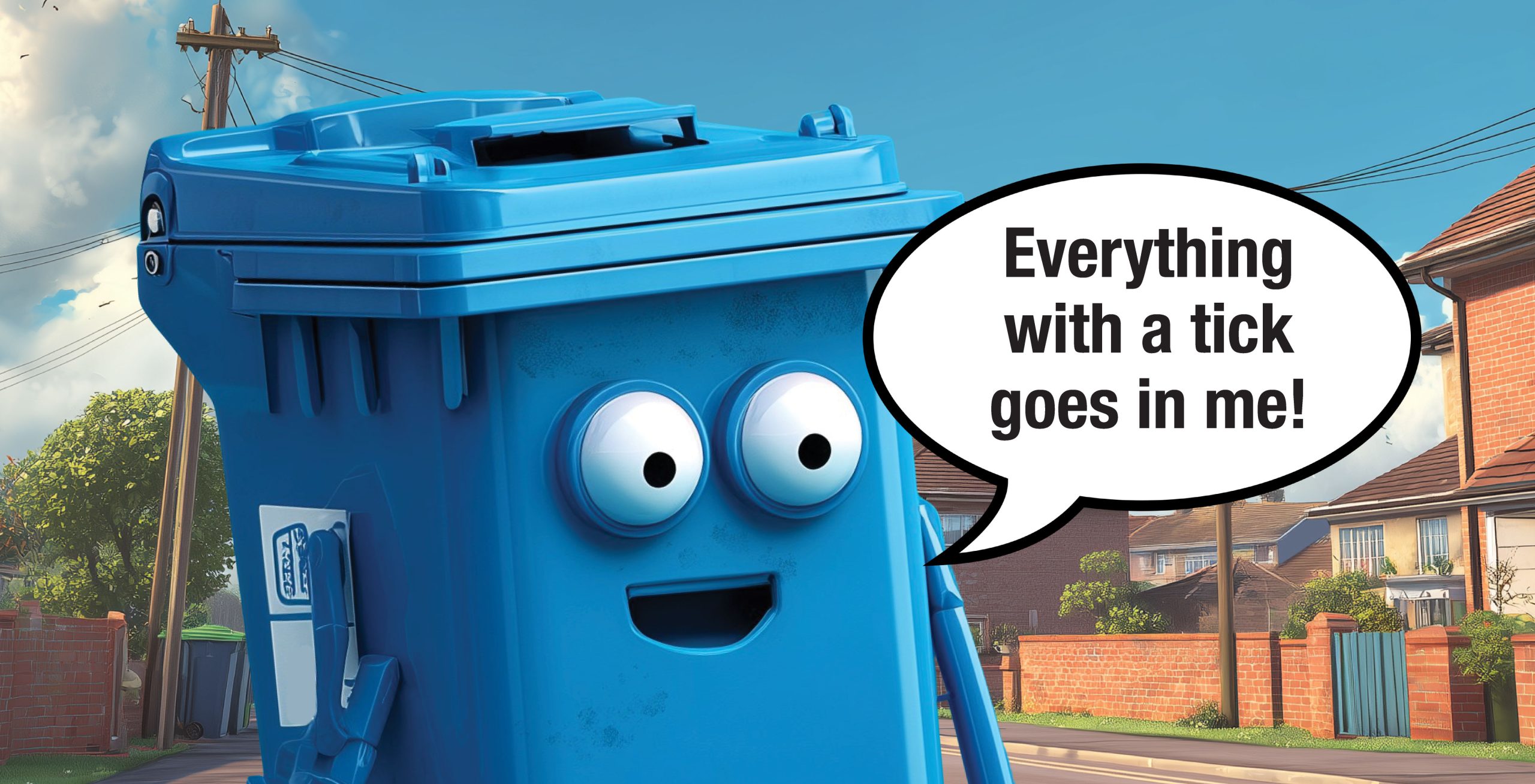
Do you know what products are perfect for your blue bin?
Not everyone does, and that’s ok! That’s why we’ve put together a list of everything you need to know about what goes in your blue bin.
We hope by doing this, we can all work together to recycle better!
So, let’s take a look.
Blue bin or bag – recycling
✔️ Yes please
Place all items loose in the bin — do not put them inside plastic bags:
✅ Yoghurt pots, plastic tubs, food trays, foil or foil containers
✅ Juice cartons (Tetra Pak)
✅ Aerosols (empty)
✅ Sweet tins
✅ Plant pots – all colours except black
✅ Glass – leave lids on glass jars and bottles
✅ Cans – do not crush
✅ Paper, magazines, newspapers, junk mail, catalogues, phone directories and wrapping paper which is not plastic or metallic
✅ Envelopes including plastic windows
✅ Cardboard food boxes, inner toilet or kitchen roll and egg cartons – flattened
✅ Cereal, cardboard packages with plastic padding removed and food boxes
✅ Plastic drinks, shampoo and cleaning bottles – lids on, do not flatten
✅ Yoghurt pots, plastic tubs, food trays, foil or foil containers
✅ Juice cartons (Tetra Pak)
✅ Aerosols (empty)
✅ Sweet tins
✅ Plant pots – all colours except black
✅ Glass – leave lids on glass jars and bottles
✅ Cans – do not crush
✅ Paper, magazines, newspapers, junk mail, catalogues, phone directories and wrapping paper which is not plastic or metallic
✅ Envelopes including plastic windows
✅ Cardboard food boxes, inner toilet or kitchen roll and egg cartons – flattened
✅ Cereal, cardboard packages with plastic padding removed and food boxes
✅ Plastic drinks, shampoo and cleaning bottles – lids on, do not flatten
✘ No thanks
We will not empty bins or recycling bags which contain the following:
❌ Black bag waste
❌ Plastic bags, cling film or plastic padding
❌ Metal objects, shredded paper or polystyrene
❌ Food or liquids
❌ Textiles, clothes and shoes – take clothes and bric-a-brac to your local charity shop or recycling bank
❌ Paint tins – donate leftover paint to your local community repaint scheme
❌ Electrical items – take these to your nearest recycling centre or arrange a bulky item collection
❌ Syringes
❌ Wood
❌ Black bag waste
❌ Plastic bags, cling film or plastic padding
❌ Metal objects, shredded paper or polystyrene
❌ Food or liquids
❌ Textiles, clothes and shoes – take clothes and bric-a-brac to your local charity shop or recycling bank
❌ Paint tins – donate leftover paint to your local community repaint scheme
❌ Electrical items – take these to your nearest recycling centre or arrange a bulky item collection
❌ Syringes
❌ Wood
Topics
Need Something Else?